By Nuvia C. Ruland, Director of Professional Learning Team, High Tech High Graduate School of Education
Created by High Tech High teachers for all educators, the Kaleidoscope for Deeper Learning is a framework to design, reflect, and evaluate Project-Based Learning (PBL) units. High Tech High Graduate School of Education (HTH GSE) integrates the Kaleidoscope into its PBL-focused professional development to reconnect teachers to the joy of learning as they design projects for their students. The framework provides a structure for students to build their Deeper Learning competencies. With the exponential implementation of AI in designing curriculum in mind, HTH GSE – in collaboration with Inkwire – created the AI-assisted Kaleidoscope framework. After beta testing the AI tool with High Tech High teachers, it was made widely available to educators for free.
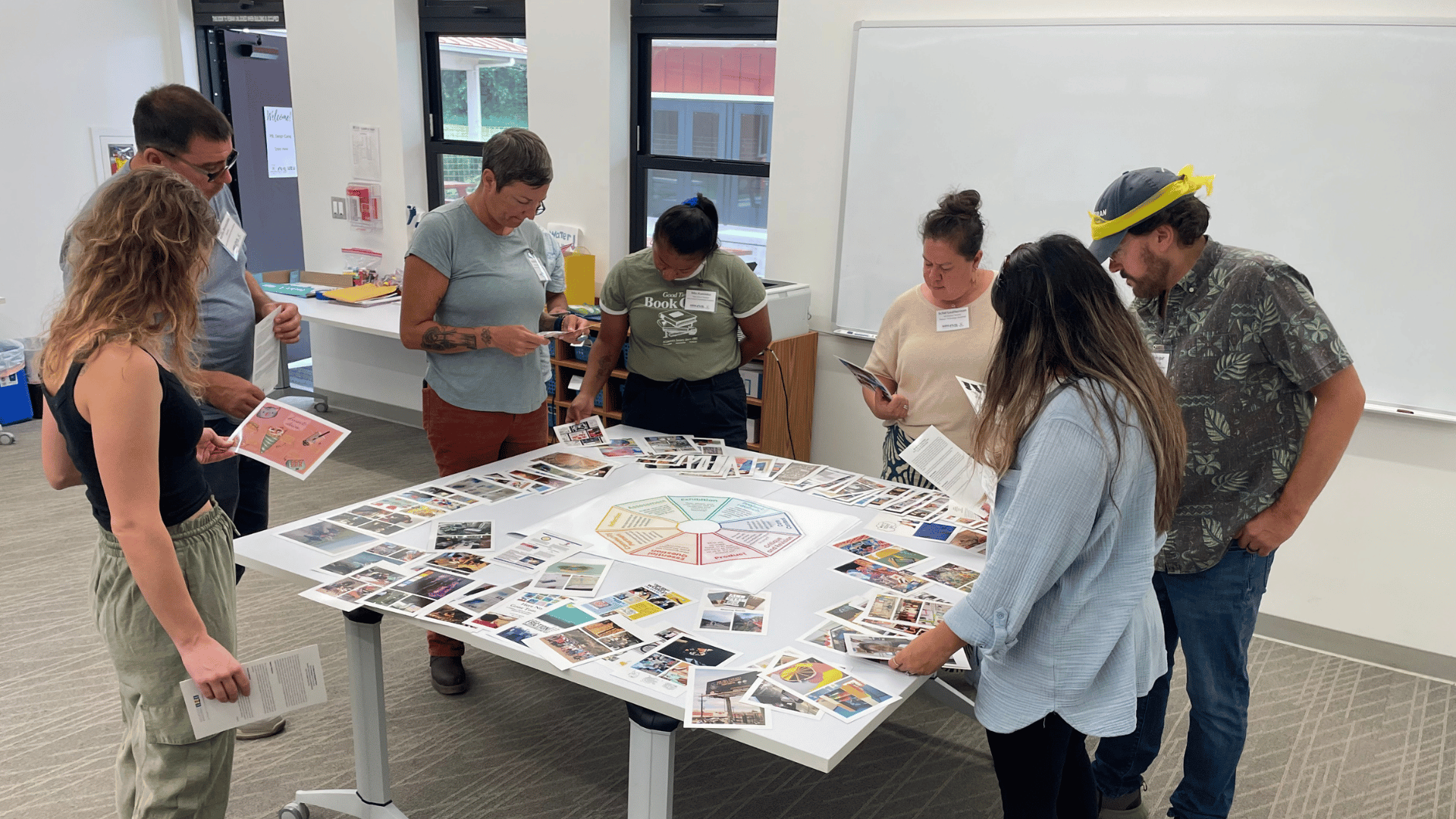
Last April, HTH GSE facilitators were invited to introduce the Kaleidoscope to the attendees of Magnet Schools of America’s national conference. The conference room was filled from front to back, and the excitement was palpable as educators engaged with this new tool. In 90 minutes, participants applied the framework to evaluate past High Tech High projects, ideate a new project, and reflect on essential components that could be refined. “The workshop gave us the perfect blend of human creativity and AI efficiency. It was entirely hands-on, deeply practical, and left me with the exact resources I need to design truly rigorous and engaging PBL units,” said Marta M. de Tuya, Curriculum Support Specialist of Miami-Dade County Public Schools.
High Tech High is globally known for implementing PBL across its TK-12 classrooms. Through a culture of inquiry, learners – young and old – create professional-quality work. The birth of the Kaleidoscope framework is no exception to the iteration process. Since the inception of HTH over 25 years ago, founders Rob Riordan and Larry Rosenstock have identified several components essential to the design of engaging community-impactful projects: projects that support students’ development as collaborators, effective communicators, critical thinkers, problem solvers, and self-directed content experts.
Over time, additional essential components of PBL were identified by High Tech High teachers in collaboration with the California Department of Education. To this day, hundreds of California teachers participate yearly in small school teams in the PBL Leadership Academy, a yearlong PBL program subsidized by the state. During the slowdown of the COVID-19 pandemic, the essential components were further codified into the Kaleidoscope and a three-day hands-on workshop, the PBL Design Camp. Educators practice curriculum design structures over six sessions of PBL Design Camp to create a project outline that is ready to engage students.
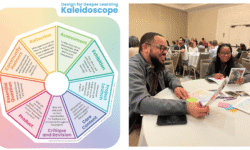
The nanogon graphic encompasses project design practices and responds to questions often asked of High Tech High staff. Questions such as: What makes up a “good” project? What must be included in a project for meaningful learning? How do you evaluate the design of an impactful project? How do you support teachers as designers of curriculum? Can you and do you encourage teachers to repeat a project? How do you design transformative learning experiences?
To introduce the framework, we engage participants in a Harvard Project Zero Thinking Routine: See, Think, Wonder. Next, we examine each of the nine essential components, which are equal in size and take up the same amount of space, reminding educators that no one component of the Kaleidoscope is more important than the other. All nine make up a project for deeper learning. Each component is bordered by an entry point toward the white circle. That circle holds the structure in place and emphasizes the cyclical nature of both the Kaleidoscope and the many cycles of PBL:
These cycles create classroom rhythms and structures to dive a mile deep into the content, instead of mile wide.
Each fragment of the Kaleidoscope is rearranged and adjusted with a single turn, the components of the framework could be rearranged by the educator to create a whole new learning experience. There is no one starting point for a project. All colors of the Kaleidoscope are in relationship to one another and highlight the interconnectedness of each component. For example, Core Content is connected to Community Partners because it enables students to demonstrate what they are learning beyond the four walls of their classroom. Core Content is connected to Exhibition because students must often share their learning with peers, guardians, community members, experts, and their teachers. Core Content is connected to a Project Launch where students can begin to play, discover, or grapple with concepts.
The Kaleidoscope framework is not just for educators new to PBL. It is also an effective tool for teachers well-versed in designing PBL experiences to continue their learning. “I am walking away with renewed energy around planning complete PBL lessons and have the tools and resources to reference while planning,” Erin Kawakami of Hawai’i Preparatory Academy recently shared after PBL Design Camp.
High Tech High teacher Maria Elena Valenzuela, who participated in a HTH Project Unpacking workshop, had this to say: “Project Unpacking provided us with a powerful reflection on project design through the Kaleidoscope lens; it gave us a blueprint to design our own projects and inspired us to center students and include community partners.”
We include the framework in our professional development to build the behaviors needed to design with an AI companion. Having the Kaleidoscope and Deeper Learning competencies as the architectural structure for AI makes it a powerful tool for educators to quickly produce a High Tech High-like draft of a project for their colleagues and students to review. This tool reduces the time an educator needs to articulate the seed of an idea into an outline that can be reviewed and analyzed by others before implementation.
At High Tech High Graduate School of Education, we aim for teachers to be playful in sequencing the essential components of the Kaleidoscope to create beautiful new forms of learning. Ultimately, the Kaleidoscope is a reminder that meaningful project-based learning is not about following a formula, but about giving educators the tools and flexibility to design experiences that inspire curiosity, connection, and deeper learning.




4005 Wisconsin Avenue NW #5997
Washington, DC 20016
202.824.0672